Saturday, January 7, 2012

Hockey and Fishing

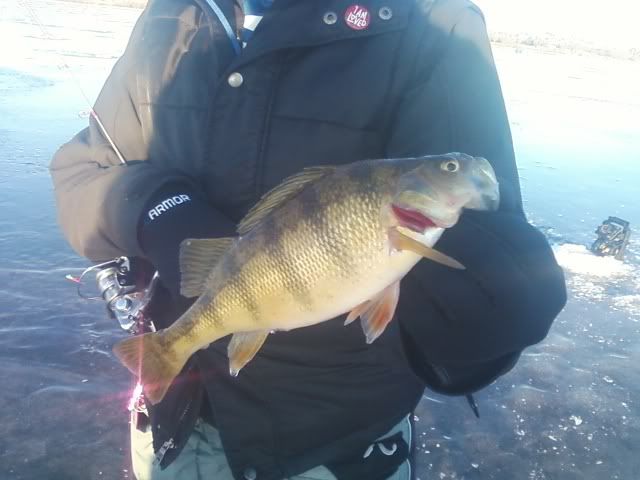
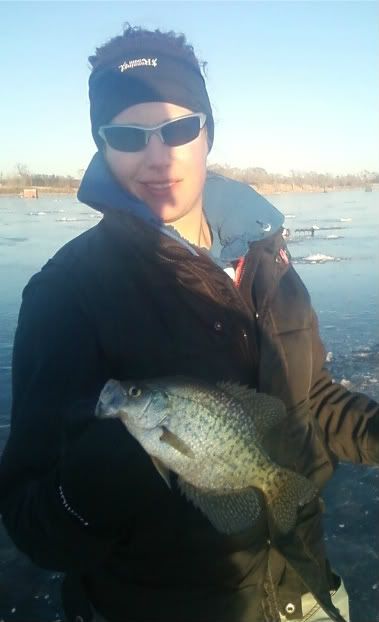
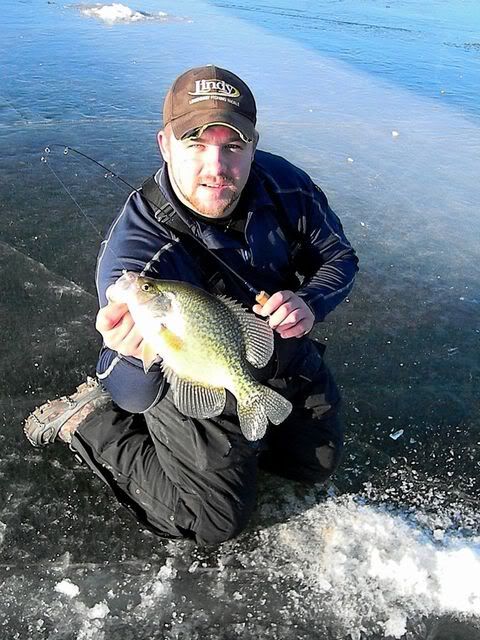
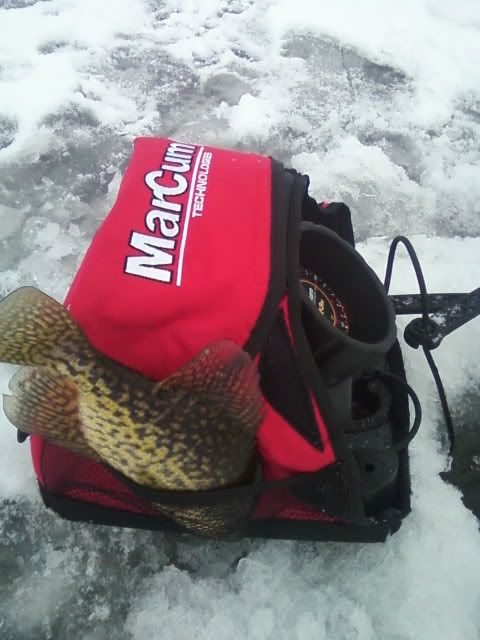
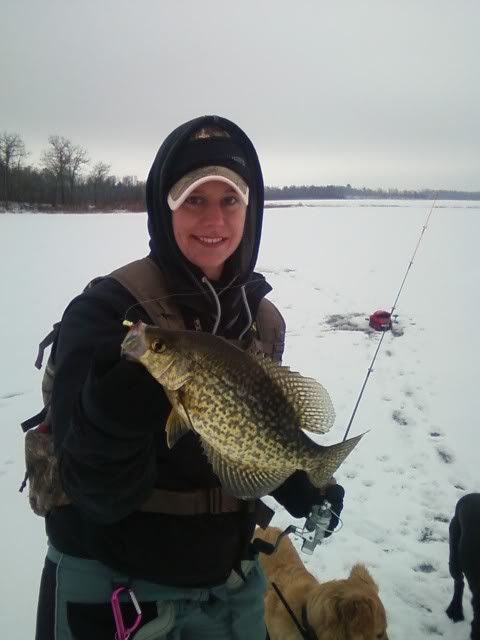
My little bro had an outstate hockey tourney this weekend and Britt and I decided to head out and watch him play a couple games, got some great photos of him playing. After watching them absolutely trounce Grand Forks early afternoon (with no help from the refs) we decided to head out to a local lake near the rink and fish for a while since they didnt play again until after dark. I am glad we headed out!

With no maps or info aboot the lake prior to setting foot on it, we decided to edge a group of guys who were out fishing. Started marking fish right away but most were smaller perch, with a few small gills mixed in. We drilled a little more and found some larger perch and crappies, but it seemed that all of our larger fish came from spots in this little area that had white ice from snow melt as opposed to the clear black ice that was almost all over the lake.

Britt had the hot hand on the perch today, almost everyone she caught would have made a nice fillet had we been keeping any fish. After getting whooped up on by her for the first hour we were out there, I finally was able to get her to tell me the color combo she was using. She had on a green/glow pink bug with a red plastic. When i tied that combo on, I was quickly able to catch up. I also had on a great fish right before we left that broke me off, several expletives were yelled when that line snapped. I guess next time I will remember to check my drag before I head out fishing...


Monday, January 2, 2012

New Years Weekend


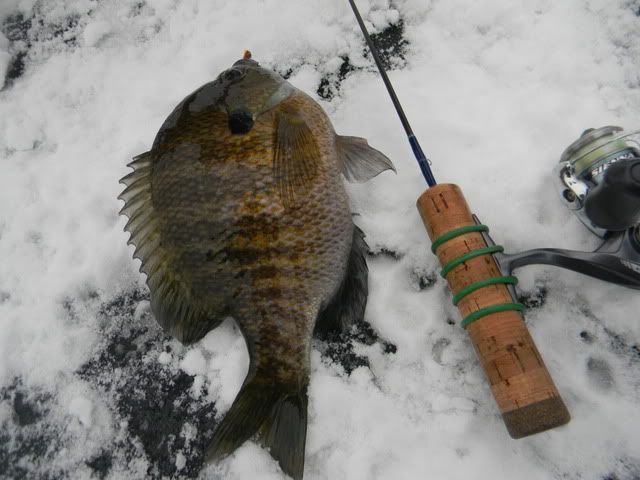
Was up in the Crosby, Mn area for a long new years weekend. Got onto some great fish on Saturday, but when that cold front came pushing through it shut almost everything except for the bass and some small bluegills off. Got some awesome fish Saturday hopping around on a basin area, they were really on the move so we had to stay on top of them. We were rewarded with some nice gills and crappies though. Kept a few small fish for a fry and put the big girls back to be caught another day.

Sunday was an entirely different story. Cold and wind came roaring in and no one was too eager to get out on the ice right away. We made the decision to just watch tip-ups from the cabin and we had a lot of action right away, but missed quite a few fish, but we were able to land a few bass. Probably would have had a lot more action but we werent checking on the tip-ups too often. One of the tip-ups a northern had left his mark on a sucker and when it was reset, the bait was down in the weeds. On another, we had a jigging spoon with a small sucker and when we went out to pull it out near dark it was discovered that the bait had been stolen and the treble hooks were tangled on the line. And on the final tip-up, the flag had froze down with blowing snow and a bass had it for quite a while. He was very deeply hooked, so we kept him for a meal.

Monday was another blustery day, but we made the decision to head out and camp in the portables. Had to turn the heat down or off several times as that thermal fabric kept it really warm. Found some light biting bluegills and Britt broke off a nice bass. Made a short move to slightly deeper water over some mud and found a christmas tree of crappies on the flasher. I even managed to catch a shiner that we promptly put down as bait. Unfortunately, the most of these crappies that were schooled up were rather small. All in all a good weekend with great company, even if we weren't able to stay up till midnight on new years eve.


Wednesday, December 28, 2011

The Spot Off the Spot

The Spot Off The Spot
By: Bob Bohland

            I have always been a big proponent of finding your own spots to fish on a lake. The advantages of exploring new ground are numerous; including being able to fish unpressured fish, finding new secret spots, and having a little bit of privacy on the lake. There are, however, some occassions where it is beneficial to fish near the crowd. On many smaller lakes there really isnt any way to get around fishing near the crowd, and even on some of the bigger lakes there may only be a few small pieces of structure available that will hold fish. So when you cant get away from the crowd, use the crowd to your advantage.
            The first step to take when you find yourself stuck near a crowd of “sheeple” (so named because they seem to enjoy herding up onto small areas on a lake), is to look at a good lakemap. Crowds generally setup over deep holes where inactive fish will suspend thinking that a lot of fish on their flasher means they are going to catch a lot of fish. The problem with this is that when you are stacked up with a large group of people, fish get wise to seeing the same lures presented the same way and often get turned off by the commotion caused by the sheeple above them.
            The trick to catching fish near these groups is to use a bait that is totally different than what the other anglers are fishing. I generally upsize in these instances, but just going from a waxworm to a minnow is not enough. Grab a big aggressive search bait like the Lindy Darter, the flash from the holographic baitfish patterns will give the fish a totally different look than they are seeing from the masses drowning waxworms on small teardrop jigs. The internal rattles on the bait will also call the aggressive fish in from a distance, something a waxworm just can’t seem to do.
            Often times these groups will be set up on basins that have very good mid-depth flats near them that often remain overlooked. When you can find one of these mid-depth flats that has a fair amount of green weeds it will hold a lot more active fish than the schools the crowds are parked over. The reason for this is two-fold. One, the fish will be pushed onto these flats by the commotion caused by the crowds; and two, the green weeds on these flats will hold baitfish and aquatic insects. When I talk about baitfish, I am not only talking about small minnows in the lake. Many anglers don’t seem to understand how much panfish, especially big crappies, will feed on young of the year bluegills and perch, so two of my favorite colors are the chartreuse perch and bluegill patterns of the Darter.
              Another very effective way to fish crowds is to ‘edge” the group. Edging involves drilling holes around large groups of fisherman. It works because the commotion caused by the group, everything from generators to pickup trucks to people just out there to party will push the fish out from underneath the crowd. There really isnt a set distance for doing this and it can vary from 10 feet from the crowd to 100 yards, so don’t be afraid to drill a lot of holes. A good auger is a must, and it can often mean the difference between a bad day on the ice and actually finding active fish. The Strikemaster Solo is my first pick, it will outdrill anything else on the market and is light enough to make a day of drilling holes nothing but a minor affair. I often get a little overboard with mine because it makes drilling holes actually fun.
            I like to consider groups of fish houses as another form of structure. If you use the crowds properly, you can look at a group and be able to tell which way the fish will move due to the commotion. Next time you head out on the ice don’t automatically shy away from the crowds, there can be some great fishing to be had in those areas.  

Monday, December 5, 2011

Early Ice Crappie Fishing


Was able to make it out for a few hours after work today to chase some crappies. Found 3-4" clear black ice all the way out to where we wanted to fish. Wasnt long after getting the heater going and we had the first crappie on the ice. I love fishing early ice, especially when it is clear enough to see your fish fighting through the ice. Got a few more fish but all went back. The size structure was all over the place, but we did get a few over 11". Didn't have time to stop and pick up any bait but a glow plastic tipped on a Lindy Bug was all we needed tonight. It sure felt nice to be pulling some fish through the ice again, and man was the lake making some noise tonight!

Monday, November 21, 2011

Pine to Prairie Panfish

Pine to Prairie Panfish
By: Bob Bohland


            Big fish live in big fish waters. Most seasoned anglers know this. While a fluke trophy can be caught out of almost any waters; the best way to catch big fish consistently remains to travel to big fish waters. For panfish anglers in Minnesota, you need to simply pick up a road map and follow the Panfish Corridor to find your best chance at trophy panfish. This belt across the state has some of the best growing conditions for panfish, and due to the types of lakes in this region; panfish often survive even the harshest of winters that would otherwise decimate a lake in the southern tier of the state, but can still withstand the fishing pressure they often see.

Why Here?
Some of you are probably thinking that the northern lakes in the state provide better fisheries for panfish than the middle tier of lakes. But the problem with the lakes in much of the northern parts of the state is their trophic classification. Trophic classification is determined by several variables, but the one most focus on is the total weight of biomass in the given body of water (think bugs as food for the fish). The lakes in the northern tier of the state are generally either oligotrophic or mesotrophic. This means that they have fewer nutrients to support fast growing populations of fish and in the instance of panfish, their populations of large fish can be quickly depleted by over harvest and may take long periods of time to recover. So while these northern lakes can often have amazing fisheries, any amount of pressure can quickly dampen the chance at quality fish.
            The southern tier lakes in the state have the exact opposite problem. Many of these lakes are often in the eutrophic or hypereutrophic range. There is tons of food available for panfish to get big and get big quick. So while it may take only 4-6 years to grow a trophy bluegill or crappie in these lakes, they often will not live longer than that due to lack of oxygen in the lakes during harsh winters. Lakes in this area freeze out very regularly, so while an angler may find an amazing fishery for one or two years, it can just as easily die off during a long winter.
            Lakes along the Pine to Prairie Corridor are right in the middle of the two extremes. Classified along the line of mesotrophic and eutrophic, they mostly have abundant food sources, and are big and deep enough to provide ample oxygen during a long winter to ensure the survival of a fishery. So these fish can grow fast and have the ability to live for a long time without the occurrence of winter kill. The majority of these lakes fall within a corridor of where the big north woods meets the prairies of southern Minnesota, essentially following Interstate 94. The best areas to target can  be found by looking at the Minnesota DNR's ecological provinces map, as they all fall in the Eastern Broadleaf Forest section.

Narrow It Down
            Now this doesn’t mean that all lakes in this region will pump out trophy bluegills and crappies by the bucket load. It may take some homework to narrow down the best waters in the area. While many smaller lakes in this region can kick out some very nice panfish, small lakes are susceptible to over harvest just as much as the big northern lakes. Your major focus should be on lakes that are at least 250 acres in size and are known to produce quality fish, as it won’t do any good to go fish a lake that doesn’t even have a panfish population. Bigger lakes also have the added benefit of offering areas that hold fish that have often been overlooked by the masses. Although that isn’t to say that you won’t find a tiny little hidden gem from time to time, but they are more the exception than the rule, as this strip of lakes also has a large amount of human population in the area.
            A good lake map is your best friend when it comes time to find these plethoras of panfish and if the map shows bottom composition, it’s even better. These fish get big fast because of the amount of aquatic invertebrates in the water. They will consume these insects in mass amounts while packing on the pounds. Many anglers don’t understand how to incorporate lake maps with the type of insects the fish are keying on. For instance, if the fish in the lake you are fishing generally eat daphnia or freshwater shrimp, shallow to mid-depth flats with green weeds are the best spots to key on. Pelican Lake in Albertville, Mn is a good example of this type of lake. It is a shallow bowl that seems to pump out ridiculous numbers of big panfish every year due in large part to the overwhelming numbers of freshwater shrimp  and other invertebrates in the lake. By keying in on green weeds on this lake you can find the bigger fish as they chase these insects and other prey around.
In deeper lakes with thick mud bottoms often times the fish will tend to key on insects that spend more time in deeper water such as mayfly larvae and bloodworms. Areas to concentrate on in these lakes include mud to sand/rock transition areas and any area that you can find with the stickiest bottom possible. On your Marcum, these areas will show up as a very thin band that indicates limited sonar read back. You can test the stickiness of the bottom further by putting a depth bomb on your hook and sending it down. The harder it is to pull the weight out of the bottom, the better the fishing will often be. One great example of this is Lake Osakis in Douglas County, the panfish tend to sit on sticky bottom areas gorging themselves on invertebrates, often even going down into the substrate to fan the bugs up off the bottom.

The Payoff
Many lakes in this corridor will have both shallow and deep water species of insects, so by meticulously going through a good lake map you can pick and choose how you want to target the fish. For fish in shallow water, anything less than 15-20 feet, baits that can get down into the weeds quickly and stir things up work really well. For fishing shallow lakes for panfish such as Pelican, I like to go with the Lindy Toad. It fishes heavy, like a bait 3 times it's size, and has the weight needed to punch through any aquatic vegetation. This extra weight is really helpful on lakes that receive a lot of pressure as the fish can often be reluctant to come up out of the weeds to eat when there are plenty of bugs available near the bottom.
Color selection is a variable many anglers simply don’t pay enough attention to, especially in shallow water, it can make all the difference in the world. Even in dark or stained waters, fish can see variations in colors a lot better than anglers give them credit for. In stained waters, such as those found on Pelican Lake, I prefer dark colors. The Viking and Coach Dog colors available on the Toad are great for this application, as they stand out far more than lighter or bright colors in muddy water.
When fishing for panfish in deeper lakes such as Osakis, the best areas to key in on are those with a “sticky bottom”. This so called sticky bottom generally provides the best breeding grounds for aquatic insects, and where there is food, the fish are sure to follow. While many anglers prefer to deadstick with waxworms or minnows in these areas, to really trigger the bigger, more aggressive fish, I prefer to dance a bait around above the fish. This is when I tie on the new Lindy Bug. With bulging eyes and a wide body, the Bug will glide out and around and quiver in place when pounded, and with eyes facing downward the fish can actually see the bait as it imitates the larvae of aquatic insects. By watching your flasher, you can see if the fish want the bait presented on the bottom or higher in the water column. If the fish prefer to eat something closer to the bottom, the new smaller sizes in the Slick Jig are my go to. Loaded with waxworms and pounded into the bottom, the Slick Jig looks exactly like a struggling insect hatching off of the bottom and can be very hard for a fish to resist.
If your goal this winter is to catch some giant panfish, either for the wall, or just to make your buddies jealous, grab yourself a map and follow it to Minnesota's Panfish Belt. These lakes have no problem producing big panfish through the years, and you may discover a few new hotspots that you simply had no clue about.


Wednesday, November 16, 2011

Big Water Panfish

Big Water Panfish
By: Bob Bohland


            It should come as no surprise that most trophy panfish come from bigger waters. They have more forage, more habitat, and just more room for numbers of panfish to grow larger. Yet, many anglers only fish panfish on small to medium sized waters. Whether it is not realizing that there are fishable populations of good sized panfish in the bigger lakes, or whether it is just being hesitant about trying to find them amidst thousands of acres of water, they are missing out on some of the best trophy panfishing available. But with a little hard work, and a couple of tricks up your sleeve you can have all the panfish to yourself on big bodies of water.
            While most anglers on smaller waters tend to go right towards weedy shorelines or bays, there can often be too much of this type of structure in a large lake for an angler to efficiently dissect. Many savvy big-water panfisherman don’t bother with near-shore structure. They know that it is easier to dissect the off-shore structure in a lake, leaving them less area they have to search. There are two different types of off-shore structure that produce good-sized panfish: Mud depressions, also known as “sticky-bottom areas” and humps or “sunken islands”.
            Mud depressions can be in almost any depth of water, but the best areas to panfish generally occur between ten and twenty-five feet of water, and this is where you should focus your search. A lot of mud depressions can be very easy to find with a good lake map, there are many that will even show bottom content, though there can be many that will not be found without drilling a lot of holes. Knowing how to read a quality flasher like the new Marcum LX-7 will also help you find soft bottom areas. One of the most common places for mud to be is near the base of a dropoff where the bottom begins to level off into a flat. A large majority of the fish feeding in these muddy areas will be suspended as they chase around the aquatic invertebrates that hatch out of these areas. So you will need a bait that imitates these insects swimming around. The Lindy Bug is perfectly suited for this purpose, with large downward facing eyes that the fish can actually see, the Bug will dance around above the fish in ways that they can't resist.
            Humps are an entirely different animal altogether though. They are easily found with even the most basic lake map. There are two main types of structure on humps, weeds and rocks. Most fisherman will tend towards the weeds, which will hold a lot of fish, but they will also hold smaller fish. Panfish that tend to feed on the rock humps will be larger and more aggressive. While the Bug works great in the weeds, when it is time to find the bigger fish on the rocks, tie on one of the new smaller sizes of the Lindy Slick Jig. Load a couple of larvae or a minnow head on it and pound it into the rocks, this will create a commotion that can bring panfish in from quite a distance.
            Don't confine yourself to fishing smaller bodies of water this winter. Big lakes may take a little more work to narrow down a good pattern, but they are well worth the hassle for the size of the fish you will catch. Also since the majority of anglers who do fish big bodies of water are after walleyes and perch, you can have some amazing panfish spots to yourself all winter long.

Saturday, October 1, 2011

Rattl’N In Pannies


            There comes a time when you just have to get demolished on the ice by a veteran angler to believe what they are telling you about a certain lure. My humble-pie was served to me last winter. I was out fishing bluegills with a couple of guys, one of them being an older, experienced ice fisherman. I was making fun of him for using bait, using a jigging spoon for bluegills, and sitting in one spot on a five gallon bucket while I was hole hopping around with jigs and plastics constantly searching for big aggressive fish. I thought I was doing pretty well with some quality fish until I looked into his bucket. Wow, was I wrong! Not only did he have more fish, he had much bigger fish than I had caught.
            His weapon of choice was a 1/16th oz Lindy Rattl’N Flyer Spoon. After we were done fishing he took the time to explain to me why he was able to outfish me on the ice. The biggest thing was the rattles, he told me. While I was jumping around everywhere drilling a ton of holes and wearing myself out, he was able to sit in one spot and make the fish come to him with the sound of the rattles. The main reason for this is that sound is travelling four times faster underwater than it is above it, and with that added speed comes distance; the sound is able to travel much further because it won’t dissipate as quickly. So because the spoon has a rattle built into it, he was able to bring fish in from all over the area we were fishing.
            I have never been a big fan of livebait for panfish. It has always seemed to attract smaller fish that only seem to sit and steal the bait off my hook. But he showed me a way to hook the bait on a jigging spoon so that it would not be succeptible to theft from little panfish. The trick is to put the head of a wax worm on one treble and the tail on another. Do this with two waxworms and then dangle a third. The bigger bluegills which aren’t afraid of the larger size of the spoon will grab the first waxie and then be forced to bring their mouth over the trebles to get the rest of them, while the sound of the smaller bluegills trying to get the dangling wax worm will bring in the bigger territorial fish.
            He went on to explain to me that while rattles on a bait will call the fish in, you need more from a bait than just the ability to make noise. I was shown a few his top colors for attracting big bluegills and triggering them to bite. He preferred brighter colors such as the firetiger, rainbow, and orange perch patterns offered on the spoon. This has the added effect of a lot of flash to bring the fish in in stained water, but even in clearer lakes the holographic baitfish image on the spoons mimic what the fish are used to eating; so just a couple of colors in the 1/16th oz size can cover a variety of lakes.
            Next time you run into one of those grizzled old outdoorsmen on the ice, don’t be afraid to ask for a little advice from them. They have seen gimmicks in baits come and go and they know what works and won’t be afraid to tell you their opinions about them. You will learn a lot in just a few minutes of talking, and you will become a better angler.